

In this article:
Hiring at the executive level is the highest-stakes decision most organizations make. A Vice President, CFO, or Managing Director shapes strategy, sets culture, and controls budgets that touch every department beneath them. When that hire goes wrong, the damage rarely stays contained to a single desk — it ripples through revenue, retention, and reputation for years.
And yet, many companies still run executive searches the same way they fill entry-level roles: post the job, screen resumes, run two or three interviews, and make an offer. In a tightening leadership talent market, that approach is not just outdated — it’s expensive.
Why Executive Mis-Hires Are More Expensive in 2026
Three shifts have raised the stakes for getting executive hiring right this year:- Leaner leadership teams. Post-restructuring organizations are running with fewer executives holding broader mandates, so one weak leader now affects more of the business than in a traditional, deeper hierarchy.
- Faster market cycles. Strategic windows close quickly. A leader who spends their first year “finding their feet” can cost the company a market opportunity it does not get back.
- Higher transparency. Employees talk. Glassdoor reviews, LinkedIn posts, and internal surveys mean a struggling executive’s impact on morale becomes visible — and searchable — far faster than it used to.
What a Bad Executive Hire Actually Costs
Most leadership teams underestimate this figure because they only count what shows up on an invoice: the recruiter fee, the sign-on bonus, maybe relocation. The costs that actually sink a business are the ones that never appear on a single line item.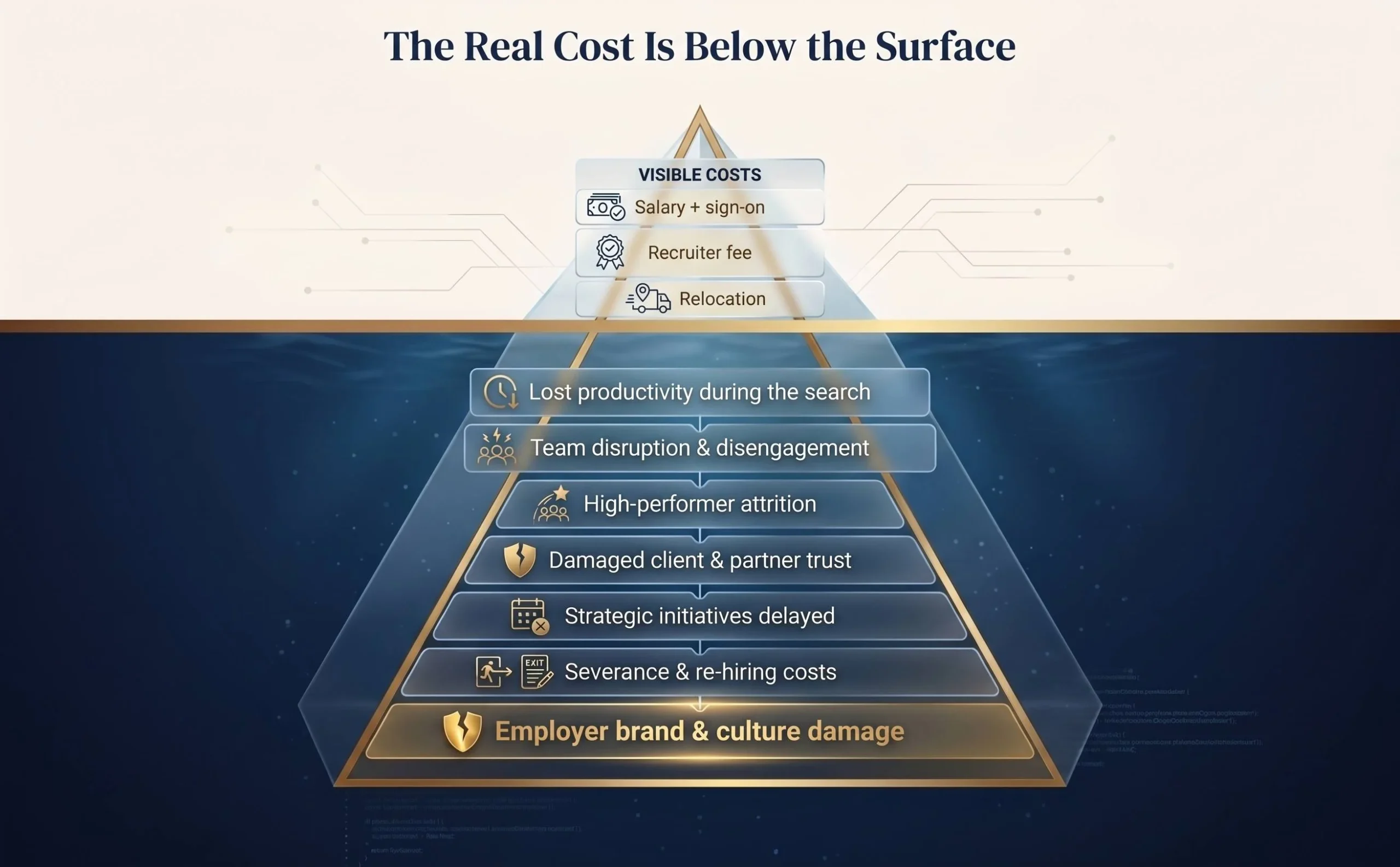 The costs you can invoice for are a fraction of the total damage.Industry research on executive attrition consistently puts the fully-loaded cost of a failed executive hire at two to five times their annual salary. For a leader earning $200,000 a year, that is a realistic range of $400,000 to $1,000,000 once every factor is counted:
| Cost Category | Why It’s Bigger Than It Looks |
|---|---|
| Recruitment & onboarding | Search fees, relocation, background checks, ramp-up training — sunk the moment the hire fails |
| Lost productivity | Months of underperformance in a role that is supposed to be driving results, not consuming them |
| Team disruption | Direct reports lose confidence, disengage, or start quietly job-hunting under a struggling leader |
| High-performer attrition | Your best people leave first — they have the most options and the least patience for weak leadership |
| Client & partner trust | External relationships built by a predecessor can erode fast under a leader who doesn’t hold the same credibility |
| Severance & re-hire | You pay to exit the wrong leader, then pay again — fees, time, and risk — to find the right one |
| Delayed strategy | Initiatives that depended on this leader’s judgment stall or get executed poorly |
The math executives forget: a bad hire doesn’t just fail to add value — it actively destroys value that was already there, from team trust to client relationships, while consuming resources the whole time.
Why Bad Executive Hires Happen
In our experience running senior-level searches, the failures rarely come down to a candidate lying on their resume. They come down to a hiring process that wasn’t built for the weight of the decision:- Sourcing bias toward active candidates. The strongest leaders are usually employed, performing well, and not browsing job boards. A search limited to inbound applicants self-selects for people who are available — not necessarily people who are exceptional.
- Skills-only evaluation. Interview panels test whether a candidate can talk credibly about strategy, financials, or operations — but rarely test how they behave under pressure, handle conflict, or build trust with a team that didn’t choose them.
- Compressed timelines. An empty executive seat feels urgent, so companies rush the final stages: fewer interviews, lighter reference checks, faster offers.
- Reference checks that confirm rather than probe. Calling the two references a candidate hand-picked rarely surfaces a true picture of how they actually lead.
6 Warning Signs Your Search Is Heading Toward a Mis-Hire
Before the offer goes out, these are the process failures most correlated with an executive hire going wrong within the first 18 months: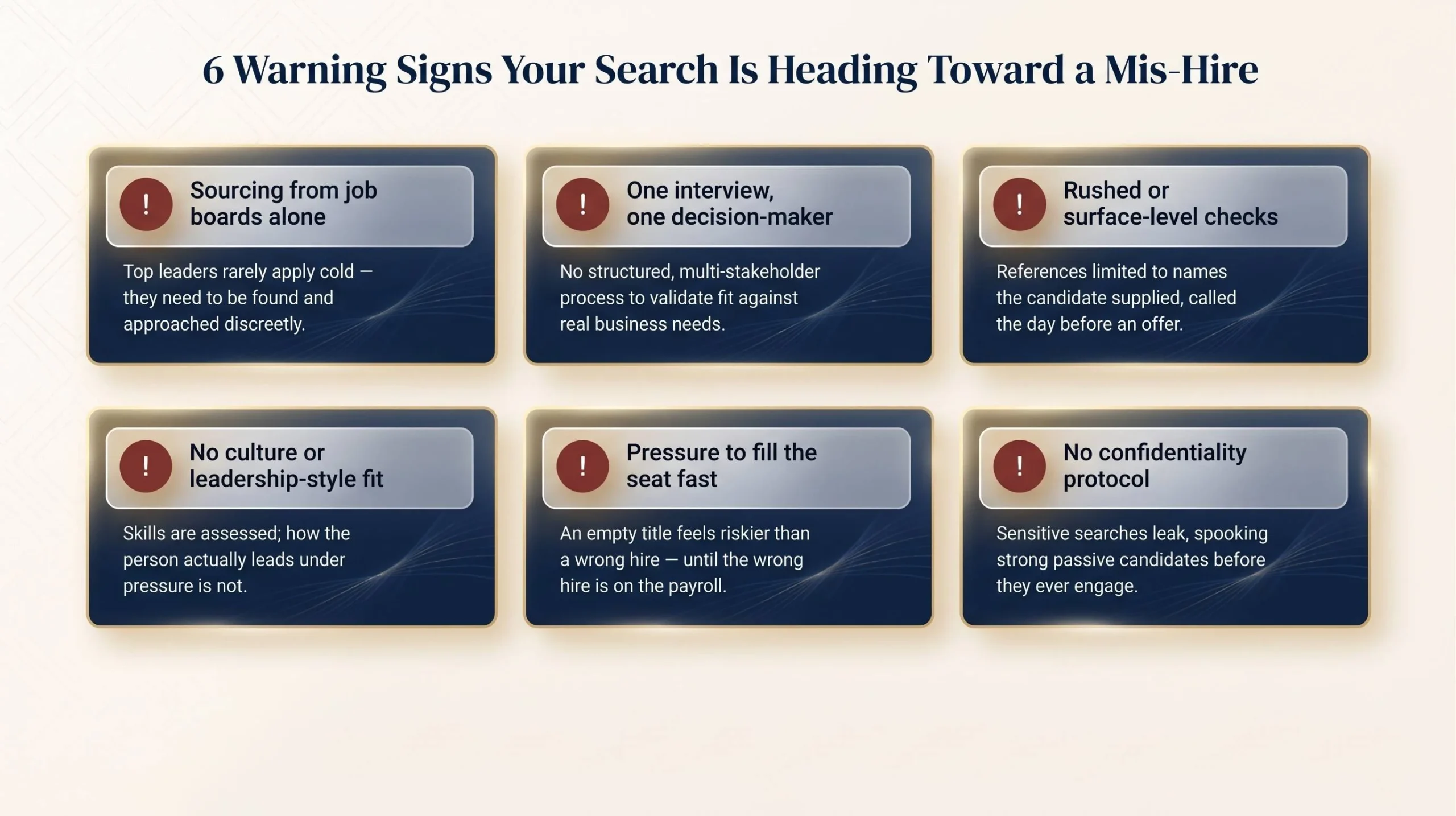 If two or more of these apply to your current search, it’s worth pausing before you extend an offer.Any one of these on its own is a yellow flag. Two or more together are a strong predictor that the process — not just the candidate — needs to change.
How Specialized Headhunting Avoids These Mistakes
The alternative to a rushed, generalist hiring process isn’t “hire slower and hope.” It’s a fundamentally different search methodology, built specifically for leadership-level risk.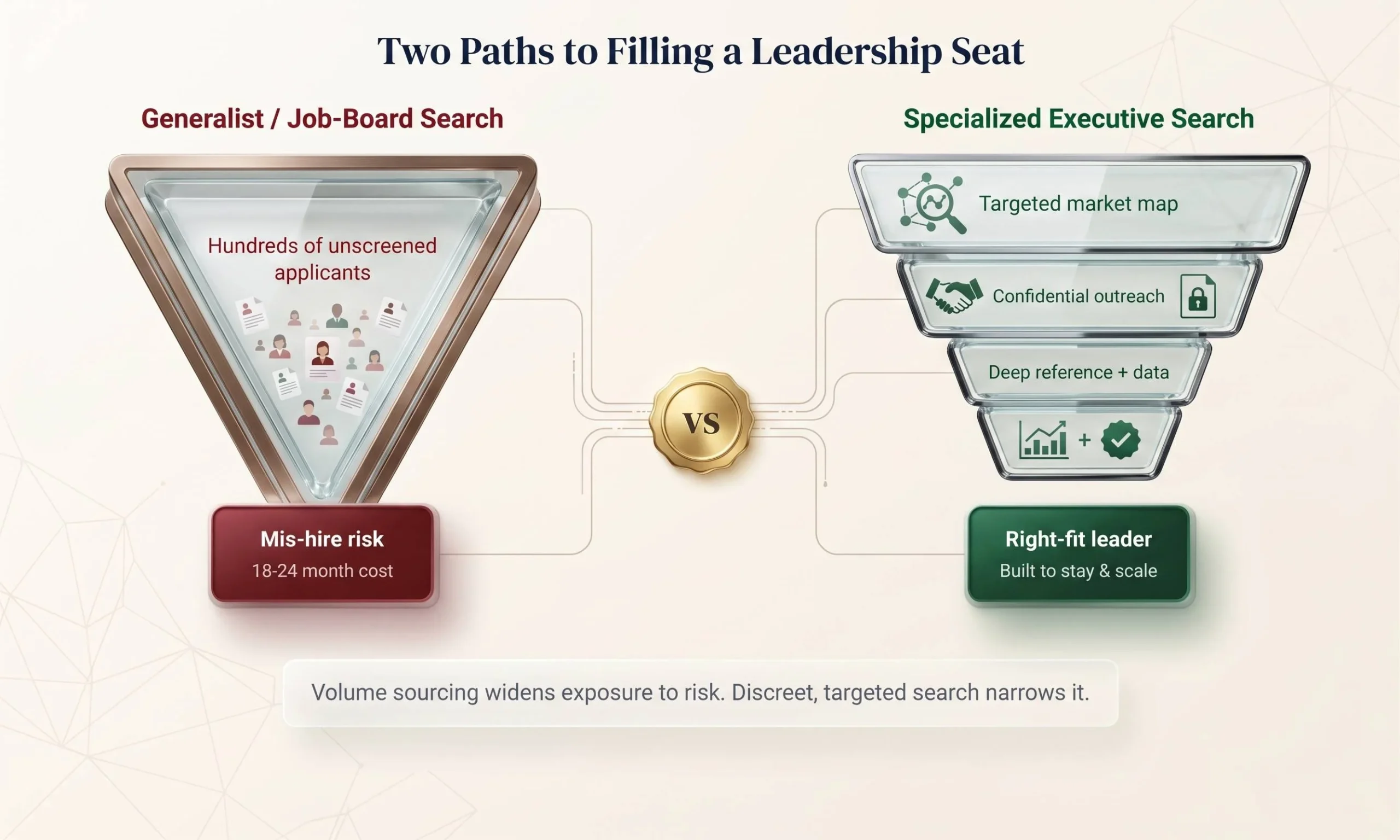 Wider, faster sourcing increases exposure to risk. Discreet, targeted search reduces it at every stage.
1. Confidential, targeted outreach
Specialized executive recruiters approach passive leaders directly and discreetly — often people who were never going to see your job posting, and who wouldn’t have applied even if they had. This expands your real candidate pool well beyond who happens to be looking.2. Structured, multi-stakeholder evaluation
Rather than one or two conversations with a single decision-maker, a proper executive search process validates fit across the people the leader will actually work with — peers, direct reports, and the board where relevant — against a clearly defined success profile.3. Deep reference and track-record verification
This goes beyond the names a candidate supplies. It means backchannel references, verification of specific claimed outcomes, and a clear picture of how the candidate led through both growth and adversity in previous roles.4. Explicit culture and leadership-style fit
Technical competence gets a candidate shortlisted. Leadership style — how they communicate, delegate, and handle setbacks — determines whether they succeed once they’re in the seat. A rigorous process assesses both, deliberately.5. Discretion that protects your strongest option
Confidentiality isn’t just about protecting your company’s plans — it protects the candidate’s current position, which is often what convinces a genuinely strong, currently-employed leader to engage with a search at all.
Hiring for a leadership role you can’t afford to get wrong?Navigation Consulting runs discreet, specialized executive searches built around your organization’s actual leadership gaps — not a generic job posting. Talk to our Executive Recruitment team →