

In this article:
Ask most hiring managers which roles keep them up at night, and the answer isn’t the C-suite search or the entry-level warehouse shift. It’s the position in between: the plant supervisor who needs to run a crew and understand the machinery, the field technician who needs a certification and the judgment to manage a client relationship on-site.
These are grey-collar roles — and in 2026, they are consistently the hardest positions on the org chart to fill.
What “Grey-Collar” Actually Means
The term describes work that doesn’t fit neatly into the traditional blue-collar / white-collar split. Grey-collar roles combine:
- Technical, hands-on competency — the kind traditionally associated with blue-collar trades and skilled labor.
- Supervisory, planning, or client-facing responsibility — the kind traditionally associated with white-collar management.
A line supervisor who has to both understand the equipment on the floor and manage the people running it is a grey-collar worker. So is a field service technician who diagnoses a mechanical fault and also owns the client relationship while doing it. The category has existed for decades, but it has become a much bigger part of the workforce as automation, compliance requirements, and client expectations have pushed technical roles to take on more responsibility.
6 Roles That Sit in the Grey-Collar Zone
Grey-collar work spans far more of the economy than most hiring teams initially assume:
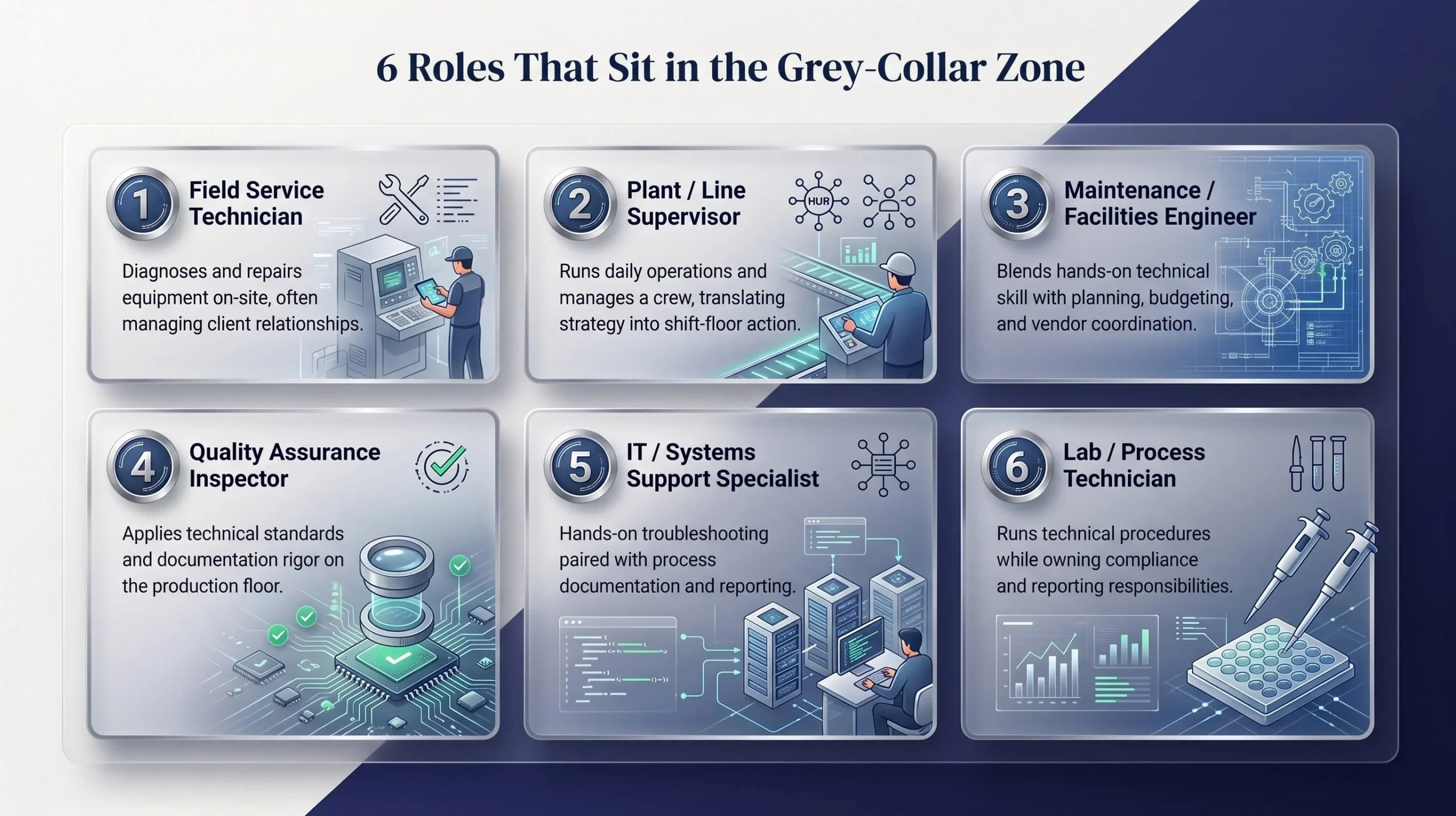
These roles show up across manufacturing, energy, logistics, healthcare facilities, and telecommunications.What all six have in common: none of them can be filled well by a generic job posting alone, and none of them can be filled by a traditional executive search process either.
Why Grey-Collar Roles Fall Through the Cracks
The core problem isn’t a shortage of qualified people — it’s that the two dominant hiring channels were built for opposite ends of the workforce spectrum, and neither one reaches the middle well.
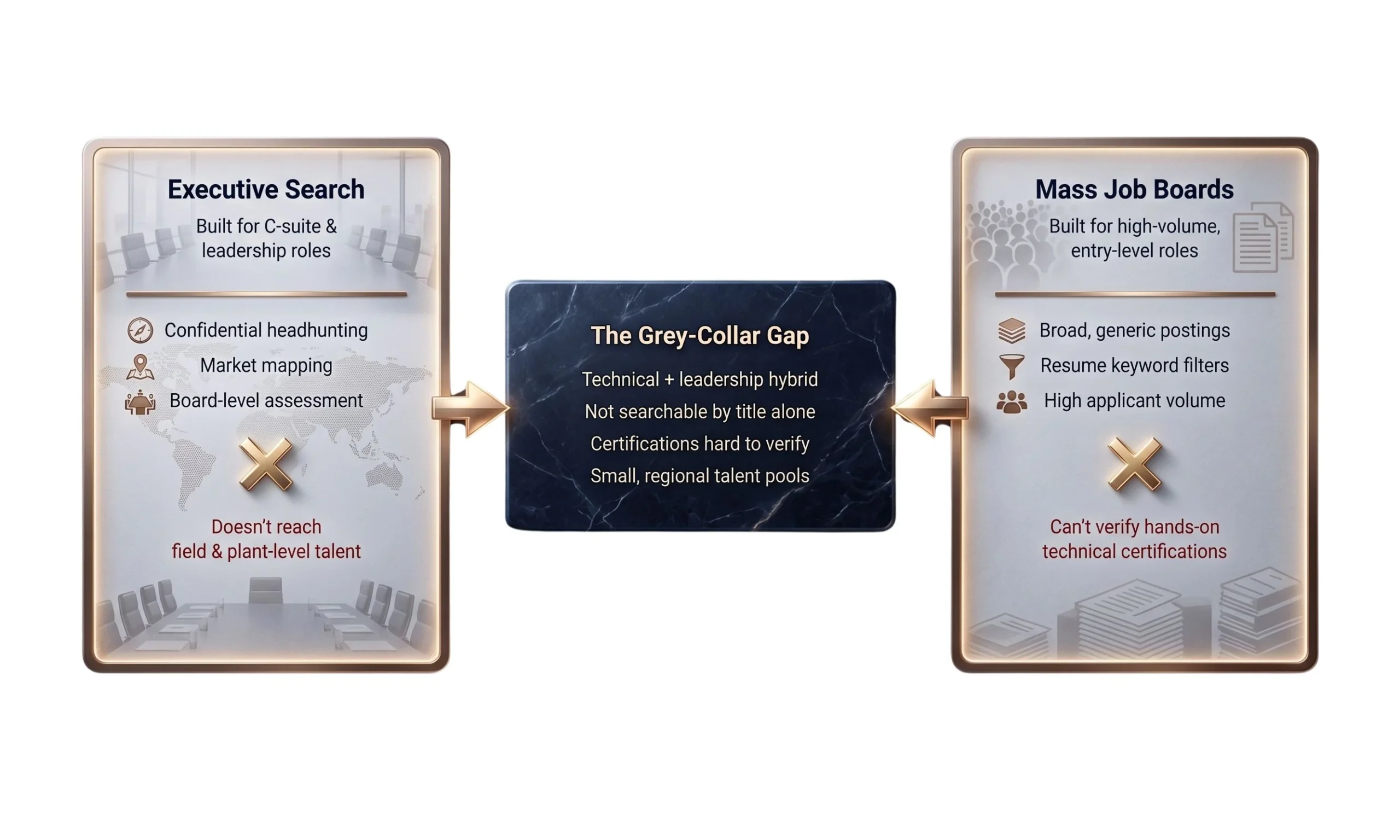
Grey-collar candidates are largely invisible to the two channels most companies default to.A few specific reasons this gap persists:
- Titles don’t standardize well. A “maintenance engineer” at one company does the job of a “facilities technician” at another — job board keyword search misses candidates constantly because of title mismatches.
- Certifications are hard to verify remotely. Trade licenses, safety certifications, and equipment-specific training don’t show up cleanly on a resume, and few recruiters know exactly what to check for.
- Talent pools are regional, not national. Unlike a remote-friendly white-collar role, most grey-collar positions require someone local, which shrinks the realistic candidate pool dramatically.
- The skill combination itself is rare. Plenty of people are strong technicians. Far fewer are strong technicians who also communicate well, manage a team, or handle a client relationship under pressure.
5 Sourcing Strategies That Actually Reach Grey-Collar Talent
Filling these roles consistently requires purpose-built sourcing, not a scaled-down version of executive search or a scaled-up version of job board posting.
Effective grey-collar sourcing blends pipeline-building with rigorous, credential-first screening.
1. Build relationships with trade schools and technical colleges
The strongest long-term fix is upstream: partnering with the institutions producing certified technicians before they even graduate, rather than competing for a shrinking pool of experienced hires after the fact.
2. Invest in apprenticeship and upskilling pipelines
Growing supervisors and senior technicians from within your existing workforce is often faster and more reliable than trying to hire the finished combination of skills externally.
3. Use structured referral incentive programs
Skilled technicians and supervisors know other skilled technicians and supervisors. A well-structured referral bonus consistently outperforms cold job board postings for these roles.
4. Screen for verified credentials first, resumes second
Build your process to confirm licenses, safety certifications, and equipment-specific training before evaluating soft factors — it filters out unqualified volume early and respects the time of genuinely qualified candidates.
5. Recruit locally and regionally, not nationally
Grey-collar hiring success is disproportionately tied to local reputation, community relationships, and regional talent networks — resources a national job board simply doesn’t have.
Struggling to fill grey-collar roles that keep stalling your operations?Navigation Consulting specializes in sourcing the technical-and-leadership hybrid talent that generic hiring channels consistently miss. Talk to our Grey-Collar Recruitment team →
Frequently Asked Questions
What does “grey-collar” actually mean?
Grey-collar describes roles that blend hands-on technical or manual work with supervisory, planning, or client-facing responsibilities — for example, a field service technician, plant supervisor, or maintenance engineer. These roles sit between the traditional blue-collar and white-collar categories and often require both a technical credential and people-management or communication skills.
Why are grey-collar roles so hard to fill?
Grey-collar roles fall outside the sourcing channels built for either end of the spectrum. Mass job boards can’t verify hands-on technical certifications, and executive search firms aren’t built to reach field-level or plant-level talent. The result is a narrow, regional, and often invisible talent pool that neither generic job postings nor traditional headhunting reach well.
What industries have the most grey-collar hiring demand?
Manufacturing, energy and utilities, logistics, construction, healthcare facilities management, and telecommunications all have significant grey-collar hiring needs — typically for roles like plant supervisors, field service technicians, maintenance engineers, and quality inspectors.
How is recruiting for grey-collar roles different from blue-collar or white-collar recruiting?
Grey-collar recruiting requires verifying technical certifications and hands-on competency the way blue-collar hiring does, while also assessing leadership, communication, and judgment the way white-collar hiring does. It typically depends more on regional networks, trade school and apprenticeship pipelines, and referral programs than either high-volume job board postings or confidential executive outreach alone.
Can technology help solve the grey-collar hiring gap?
Yes. Mobile-first applicant tracking, credential verification tools, and targeted digital outreach to trade schools, apprenticeship programs, and regional talent communities can significantly widen the visible candidate pool for grey-collar roles, though local relationships and referral networks still play an outsized role.